Simulation Demo
Simulation runs illustrate how online goal arbitration changes goal priority under shared budget constraints rather than replacing the frozen navigation backbone.
RAL 2026 | Under Review | First Author
BAT-Nav is a training-free online goal arbitrator for budgeted long-horizon semantic navigation. It estimates remaining discoverability - the probability that a frozen executor can complete a goal within additional budget - and uses marginal return to regulate four explicit interventions: Persist, Switch, Abort, and Commit.
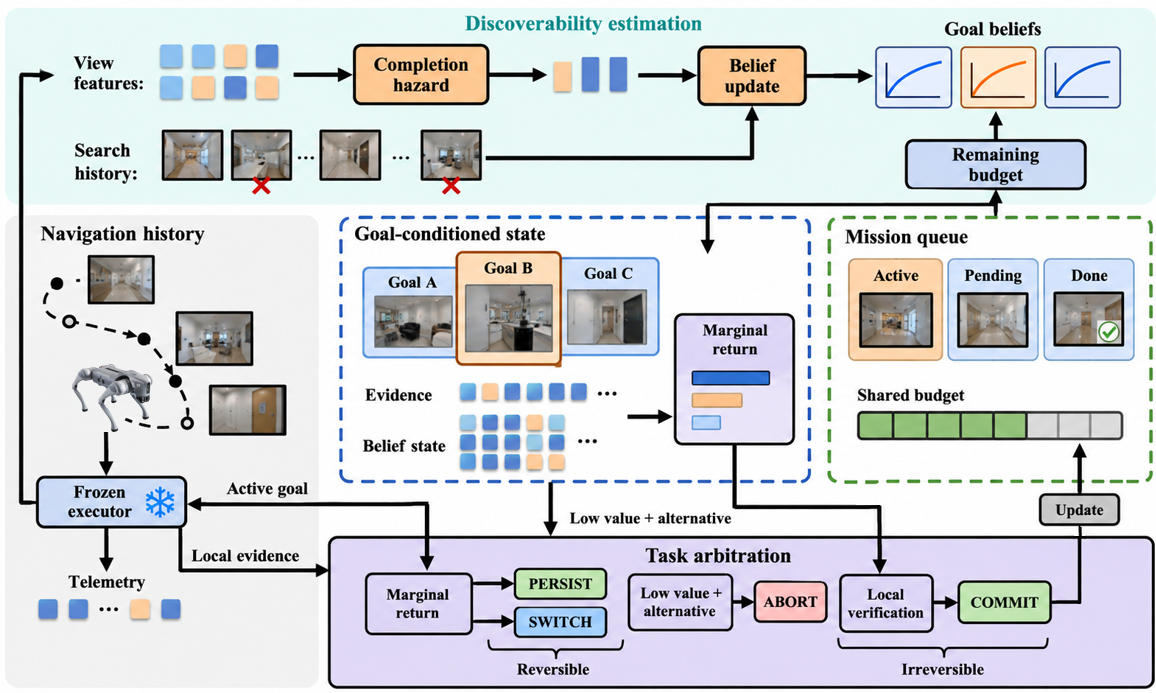
Long-horizon semantic navigation requires a robot to search for multiple open-vocabulary targets under a finite action budget. BAT-Nav targets the budget-monopolization failure mode, where a low-yield or occluded goal consumes most of the episode budget and prevents later goals from being attempted.
The arbitrator separates allocation from verification. Search feasibility and budget retention drive Abort and Switch decisions, while verification sufficiency controls Commit decisions. This keeps the low-level navigator frozen while changing which semantic goal retains execution priority.
Simulation runs illustrate how online goal arbitration changes goal priority under shared budget constraints rather than replacing the frozen navigation backbone.
The physical-system check verifies that the BAT-Nav queue interface can connect to a real navigation stack as a qualitative software-boundary test.